Shafeen Alam
← Leadership
AsurionA design team, not teams of designersLeadership

A design team, not teams of designers

Design at Asurion was embedded, a designer inside each journey team, which is a reasonable structure that had produced an unreasonable outcome. Everyone was close to their product and isolated from each other. This is how I diagnosed that with the team, what we named it, and the case I took upstairs.

Role
User Experience Director, team of 5
Structure
Designers embedded in journey teams
The work
Diagnosis, strategy, executive buy-in
Artifact
Design team strategy, March 2017
case.md
$ cat outcome
initiatives: 8 named
goals_live_in: Workday + reviews
Why it mattered

A burned-out team working in silos cannot influence strategy, and the product shows it.

60-second read

Problem

Designers sat inside separate journey teams and behaved like teams of one. Silos, redundancy, no shared process, no seat in strategy, and by the team's own account a loss of trust and burnout.

System decision

Run design as a product. Give the function its own goals, put them in the system the company already used to measure people, and staff them with tiger teams drawn across journey teams.

My contribution

Diagnosed it with the team rather than for them, named the problem in one line, and took a thirty minute case to the executives whose buy-in it needed.

Outcome

A strategy the team wrote with me, eight named initiatives, and design goals inside Workday and performance reviews rather than in a deck.

Jump to

01 · The sentence

Today we function and behave not as a design team, but as teams of designers.

That line is the whole case. It took a while to find, and once it existed I did not need much else, because every designer who heard it recognized their own week in it.

The other sentence I kept, from the same whiteboard: design is our house, we need to fix it.

02 · Diagnosing it with the team

I did not write the diagnosis and present it. We built it together on a glass wall, one problem per sticky, then clustered until the categories named themselves. Doing it that way meant nobody later had to be convinced the diagnosis was fair, because it was theirs.

Seven clusters came out of it. Only one is about craft.

Responsibility

No seat at the table. Lack of trust in design. Pixel pusher versus user experience. No awareness of how long design actually takes.

Collaboration

No support from above. Difficult to strategize with product. Things are too prescriptive. Too many meetings.

Accountability

Who has the final say. Who has the D. Too many opinions, not enough facts.

Process

No unified process for how we work together. Missing kick-off, test, review, deliver. No design sprints. Nothing documented.

No time

Straight to production. No time for iteration. Too much pressure to ship deliverables before they were ready. Work-life balance.

Tools

Too many tools, too many places to post an update, no agreement on where files live.

Style guide

No consistent UI components. No reusable symbols. No file consistency.
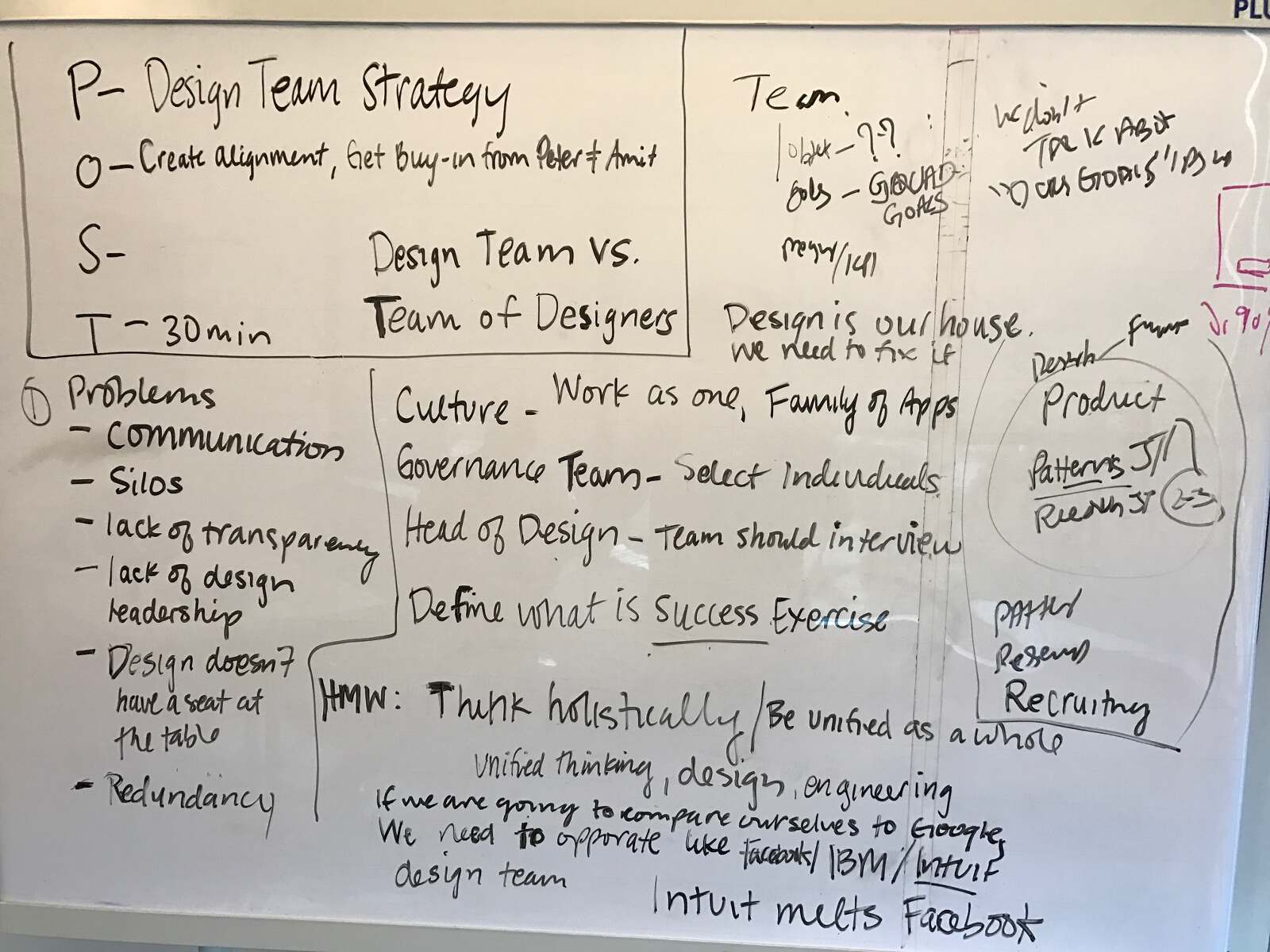
A glass wall headed Problem covered in clustered sticky notes under handwritten labels for responsibility, collaboration, accountability, style guide, tools, process and no time, with notes reading no seat at the table, lack of trust in design, who has the D, straight to production and no time for iteration
The wall. My favorite note on it is pixel pusher versus user experience, because that is a team telling you exactly how it believes the rest of the company sees it. Second favorite is who has the D, which is a decision-rights problem wearing a design costume. The most on-thesis cluster is Collaboration, where no support from above sits next to difficult to strategize with Product. Isolated from each other, and isolated from strategy.↗ open full size

03 · Framing the case

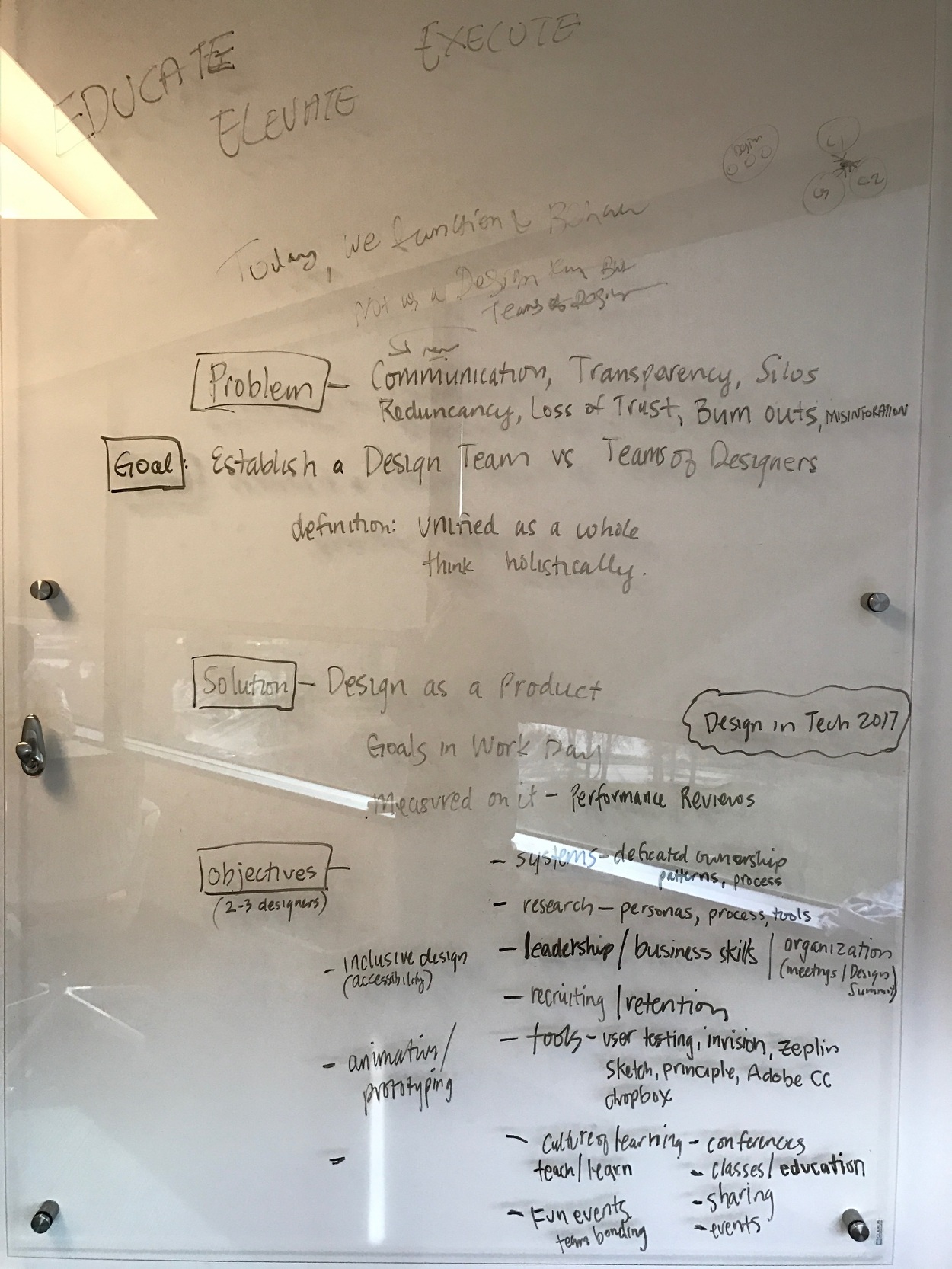
Then I had to turn a wall of complaints into something two executives would act on in half an hour. I planned it as a purpose, objective, strategy and time, wrote it on a whiteboard, and kept rewriting the framing until the problem and the ask fit on one board.
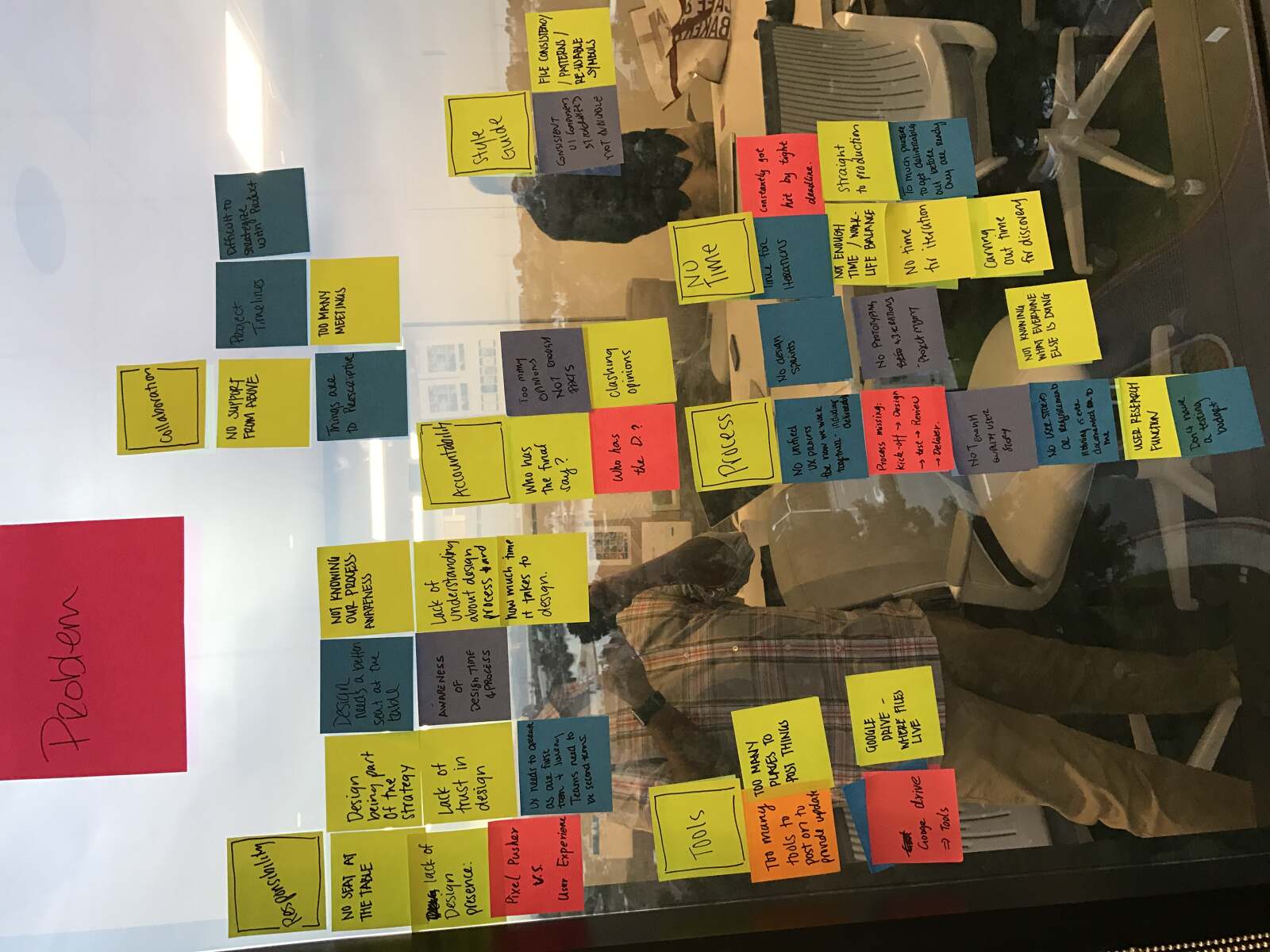
A whiteboard headed P Design Team Strategy, O create alignment and get buy-in, S Design Team versus Team of Designers, T thirty minutes, with a problems list of communication, silos, lack of transparency, lack of design leadership, design doesn't have a seat at the table and redundancy, and notes on culture, a governance team, the head of design being interviewed by the team, and the line design is our house we need to fix it
The plan for the meeting, scoped to thirty minutes. Objective written down: create alignment, get buy-in. Note the ask about the next Head of Design, that the team should interview them, and the benchmark argument at the bottom: if we want to compare ourselves to the best, we need to operate like a real design organization.↗ open full size
A whiteboard headed Educate, Elevate, Execute, stating that today we function and behave not as a design team but teams of designers, listing problems of communication, transparency, silos, redundancy, loss of trust, burnouts and misinformation, a goal of establishing a design team, a solution of design as a product with goals in Workday measured in performance reviews, and objectives covering systems, research, leadership, recruiting, tools, inclusive design, prototyping and a culture of learning
The strategy itself: educate, elevate, execute. This is where the problem list gets its two hardest entries, loss of trust and burnouts, and where the solution first appears as design as a product with goals in Workday.↗ open full size

04 · What the team asked for

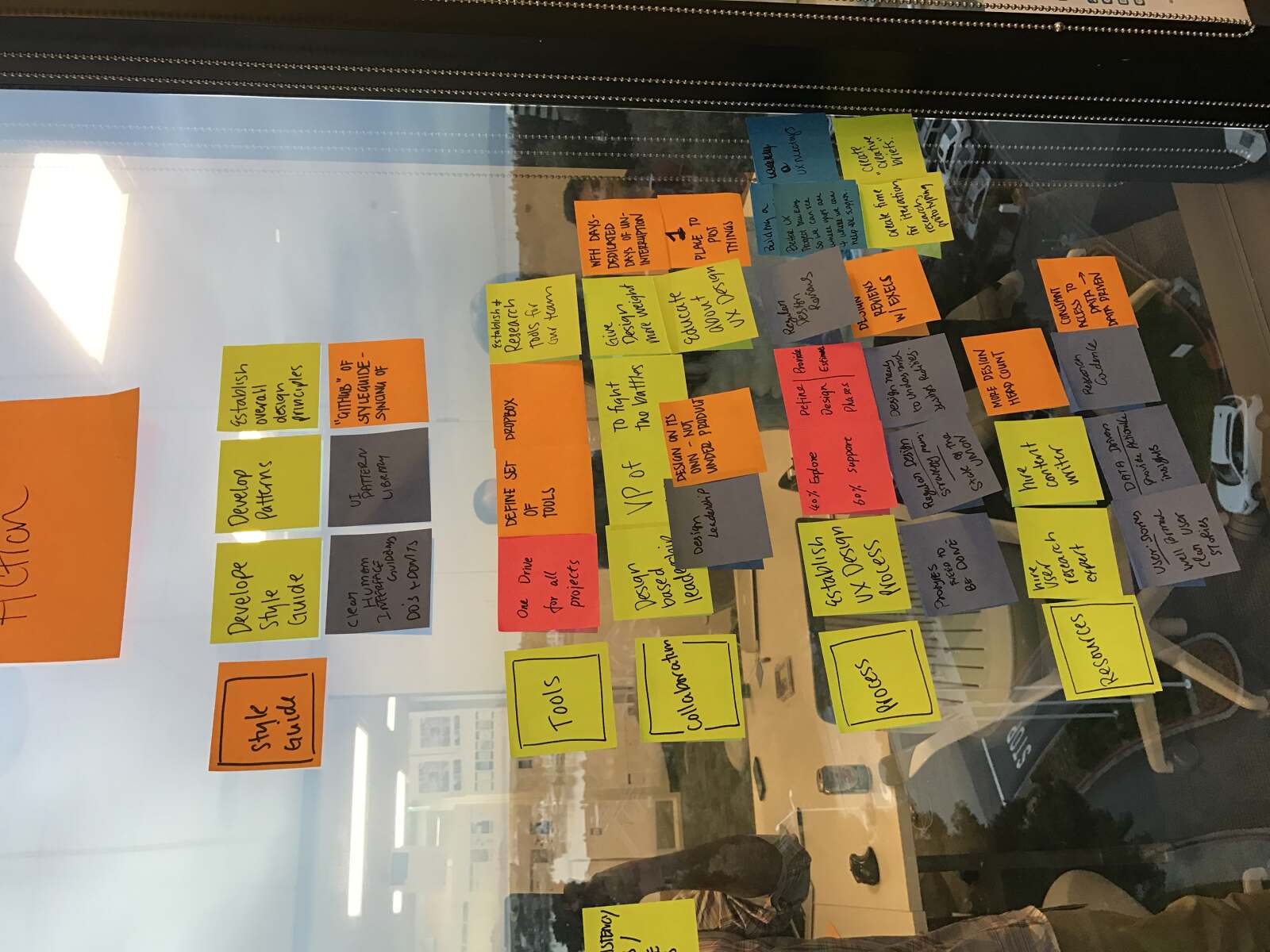
The second wall was actions, same method. It matters that the requests were specific and mostly unglamorous, because a team asking for a style guide and a defined process is not a team asking for more freedom. It is a team asking to be run properly.

Design leadership

A VP of Design, and design standing on its own rather than sitting under product. Someone to fight the battles.

A real process

Defined design phases, estimates, a 40% explore and 60% support split, design reviews with executives, and time carved out for research and prototyping.

A style guide

Patterns, principles, human interface guidelines with do's and don'ts, and a shared library rather than a folder.

Resources

A user research expert, a content writer, more design headcount, and constant access to data.
A glass wall headed Action covered in sticky notes clustered under style guide, tools, collaboration, process and resources, including develop style guide, develop patterns, establish overall design principles, a GitHub of the style guide, define a set of tools, design based leadership, VP of design, design on its own not under product, establish UX design process with a forty percent explore and sixty percent support split, design reviews with execs, hire a user research expert, hire a content writer and more design headcount
The action wall. Two notes I would put in front of any executive: design on its own, not under product, and 40% explore, 60% support, which is a team volunteering a number for how much of its own time should go to supporting delivery. That is a serious offer, not a complaint.↗ open full size

05 · Design as a product

The pitch, in March 2017. The move it makes is small and load-bearing: stop asking for design to be respected, and start treating the design function itself as a product with goals, owners, a roadmap, and a way of being measured.
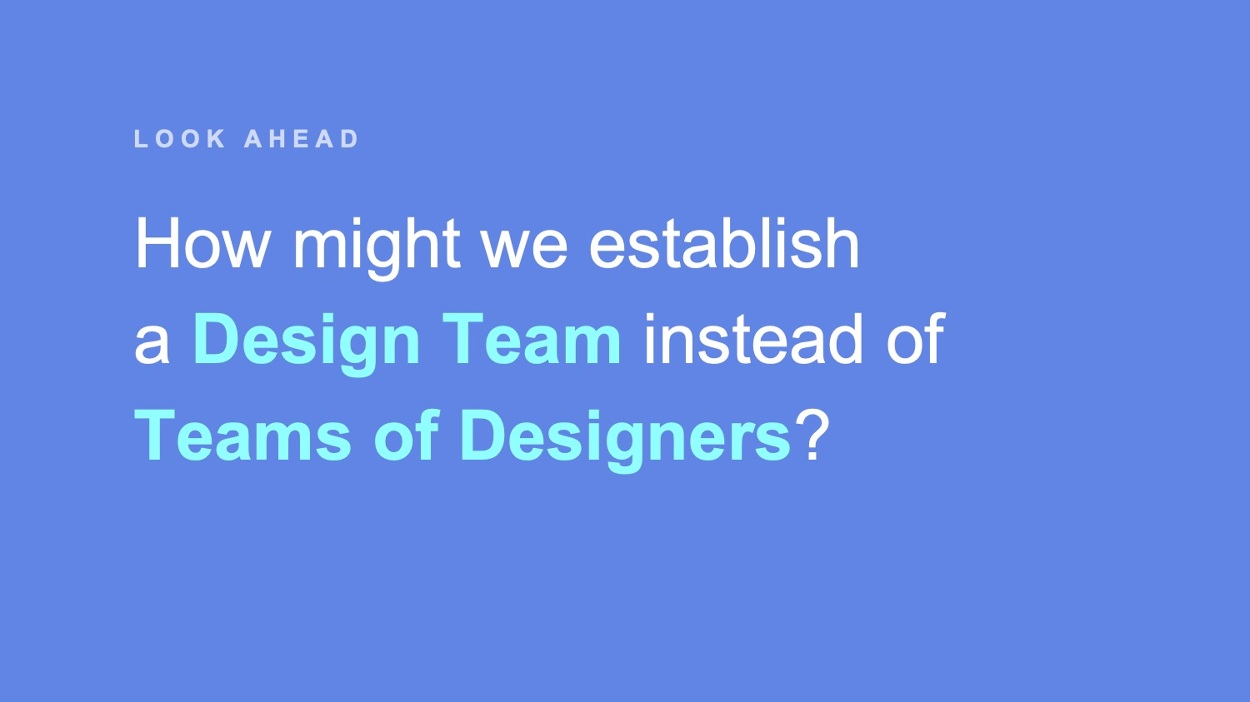
A blue slide headed Look Ahead, reading how might we establish a Design Team instead of Teams of Designers, with both phrases highlighted in cyan
The question, put to the room as a how might we rather than as a conclusion.↗ open full size
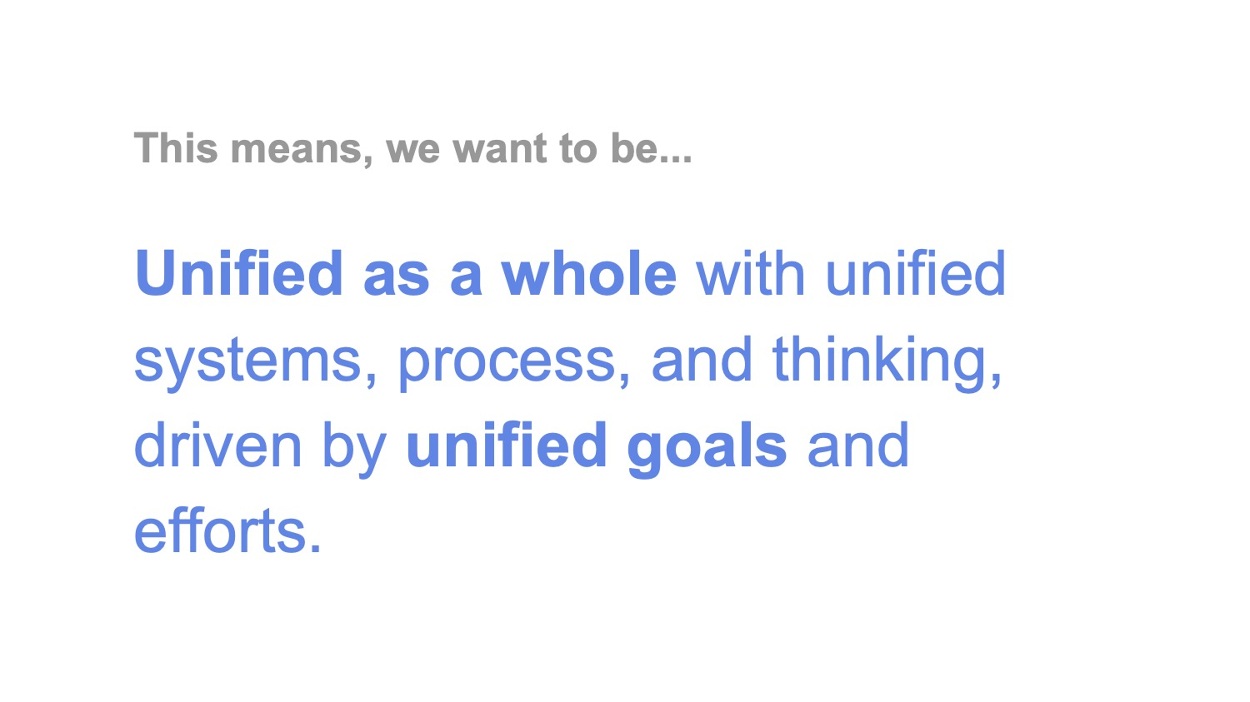
A white slide reading this means we want to be unified as a whole with unified systems, process and thinking, driven by unified goals and efforts
The definition, so unified could not just be waved at. Systems, process, thinking, goals.↗ open full size
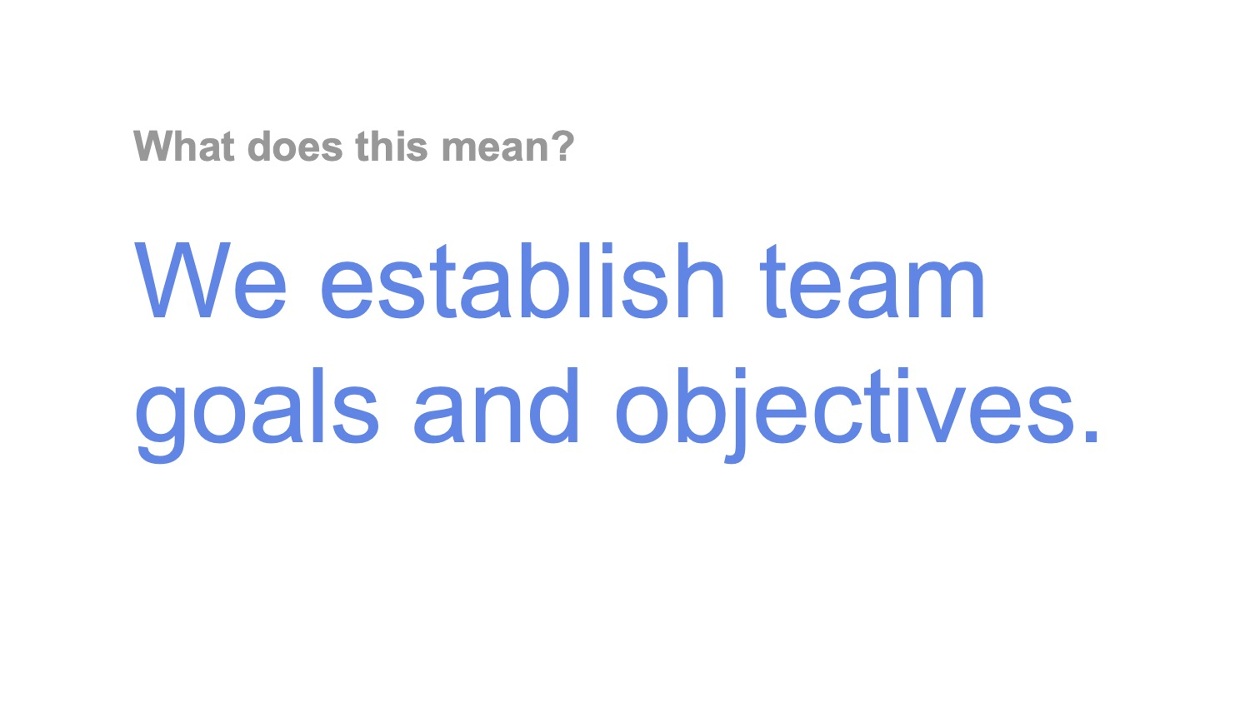
A white slide asking what does this mean, answering that we establish team goals and objectives
And the mechanism. Not a manifesto. Goals and objectives.↗ open full size
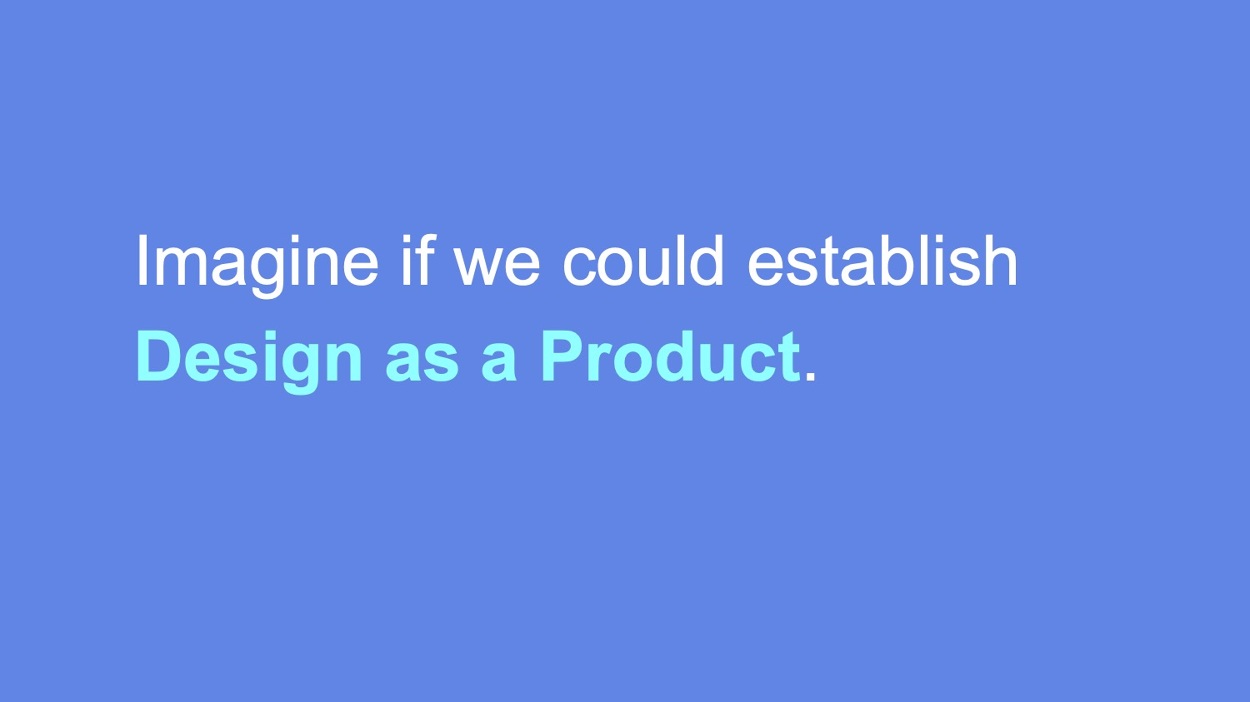
A blue slide reading imagine if we could establish Design as a Product, with the phrase Design as a Product highlighted in cyan
The reframe the whole strategy rests on. A product has goals, owners, and a roadmap. A service function has a queue.↗ open full size

06 · Tiger teams across journey teams

The structural fix. If designers are embedded in journey teams and that is not going to change, then the connective tissue has to be built deliberately: small tiger teams drawn across those journey teams, each owning one initiative, each staffed by two or three designers.

Eight initiatives. Note how many are about the team rather than the product, because that was the point.

Design systems

Patterns, intake process, design language, UI engineering

User research

Personas, process, tools, training

UX strategy

Business skills, leadership, UX meetings, coordination

Prototyping

Animations and microinteractions

Brand marketing

Brand identity, moodboard, marketing assets

Inclusive design

Accessibility, diversity of personas and perspectives

Culture of learning

Conferences, books, team events, peer reviews

Recruitment and retention

Outreach, recruiting, team building
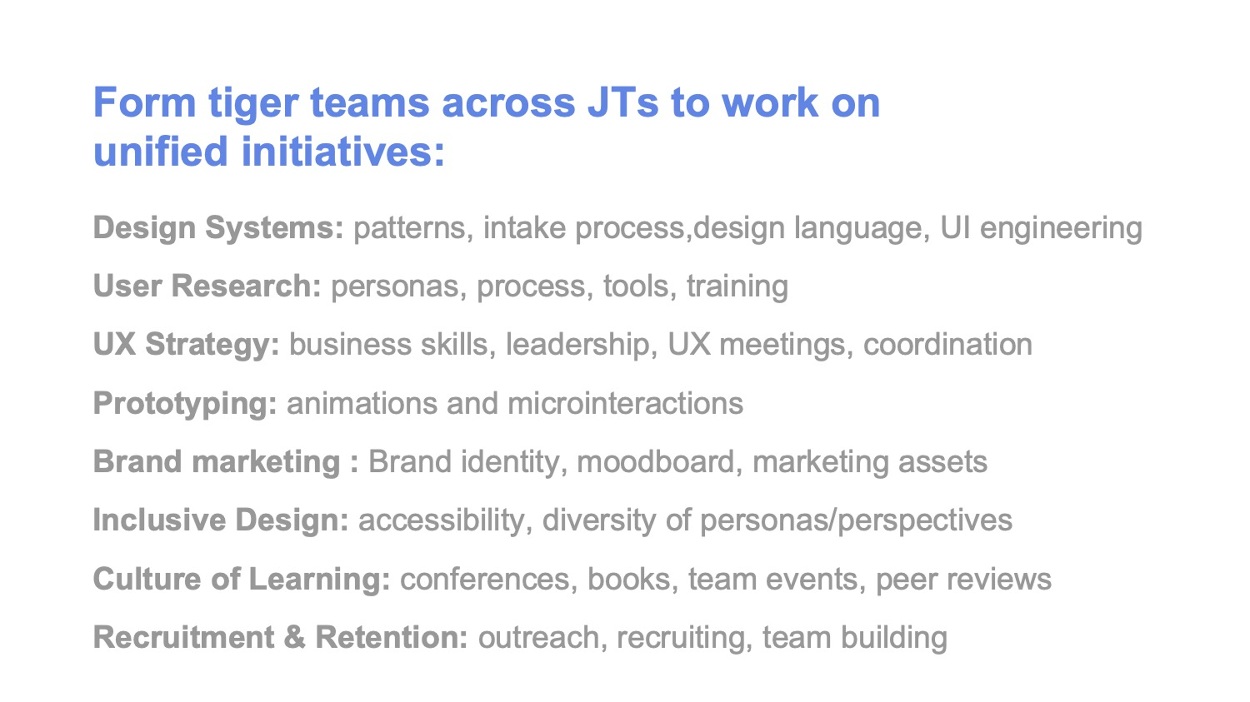
A slide reading form tiger teams across journey teams to work on unified initiatives, listing design systems, user research, UX strategy, prototyping, brand marketing, inclusive design, culture of learning, and recruitment and retention, each with its own scope
The slide as presented. Inclusive design and a culture of learning sit on the same list as design systems and research, at the same weight, which was deliberate.↗ open full size

07 · Making it survive the meeting

Most design strategy dies as a well-received deck. The only part of this I would call genuinely clever is the last slide, which is also the least exciting one.

Put the goals into Workday, the system the company already used to evaluate people. Be measured on them at performance review. Track progress openly and mark the wins.

That single move converts design strategy from extra work into the work, because it is now the thing your manager reads back to you in March. It also makes the commitment mutual. If the company agrees to the goals, the company has agreed to the time they take.
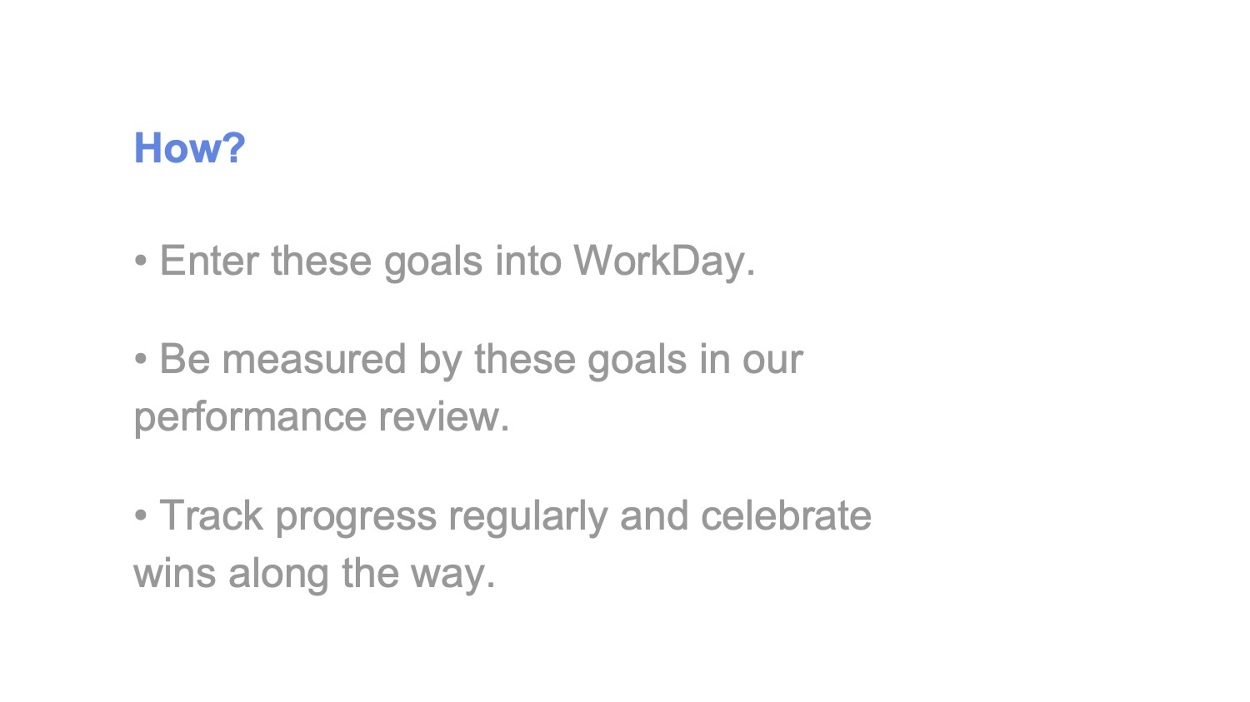
A slide headed How, listing enter these goals into Workday, be measured by these goals in our performance review, and track progress regularly and celebrate wins along the way
Three lines, and the reason any of the rest of it had a chance.↗ open full size
The title slide of the design team strategy deck, reading SMUX in large cyan letters on a blue field with the subtitle Design Team Strategy, March 20, 2017
The deck, dated.↗ open full size

08 · Meanwhile, the actual work

All of this happened alongside shipping. I mention it because design strategy written by someone who has stopped doing the work is worth very little, and because the room below is part of why the team believed the diagnosis in the first place.
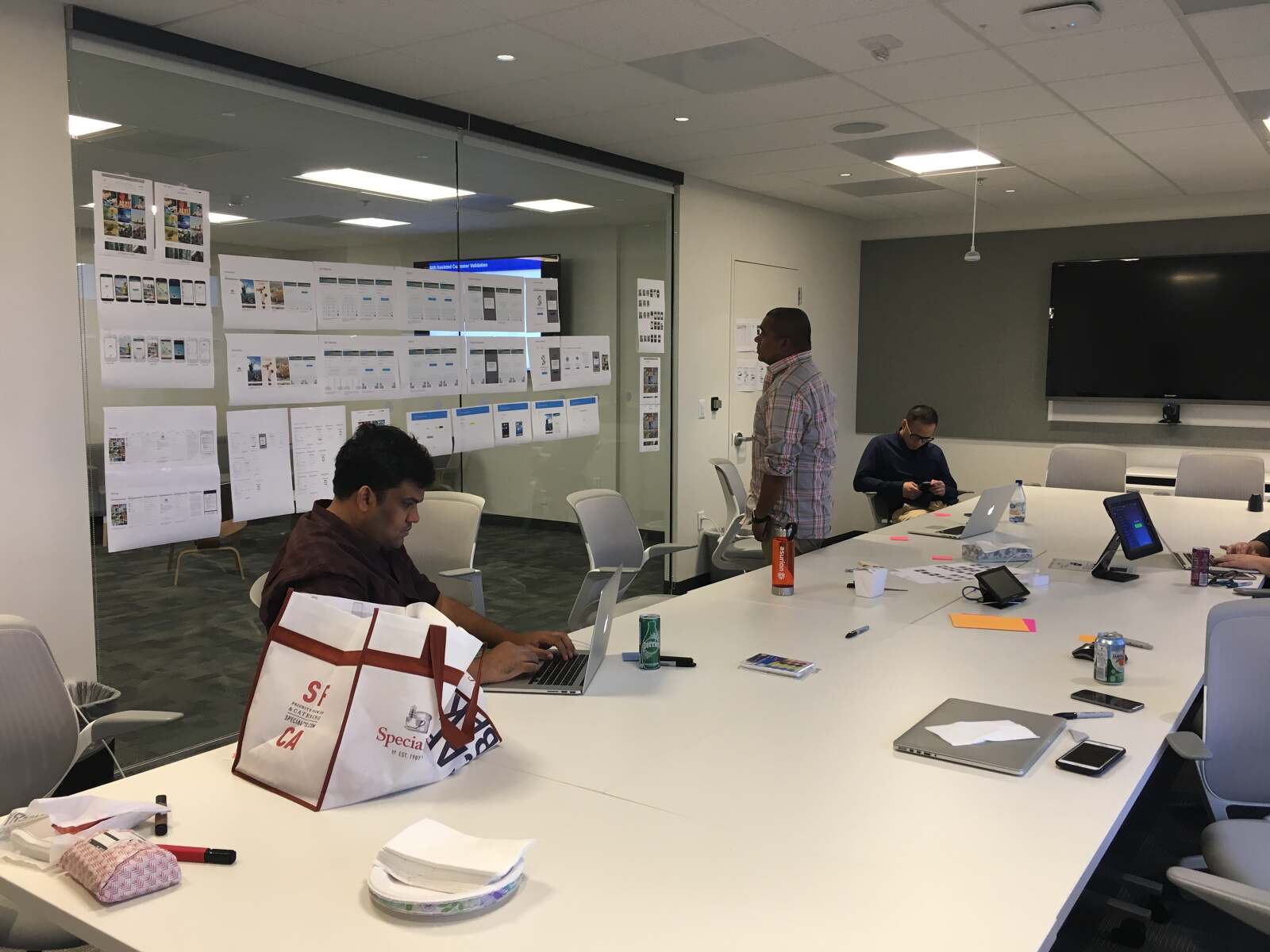
A conference room with printed wireframes and flows taped across two glass walls, a wall screen reading self-assisted customer validation, and three people working at a large table with laptops, sticky notes and an Asurion water bottle
A working session with the flows printed and on the wall, which is still the fastest way to see whether an experience holds together. The screen reads self-assisted customer validation, which in a device protection business is the moment a customer proves what went wrong without a human on the line.↗ open full size
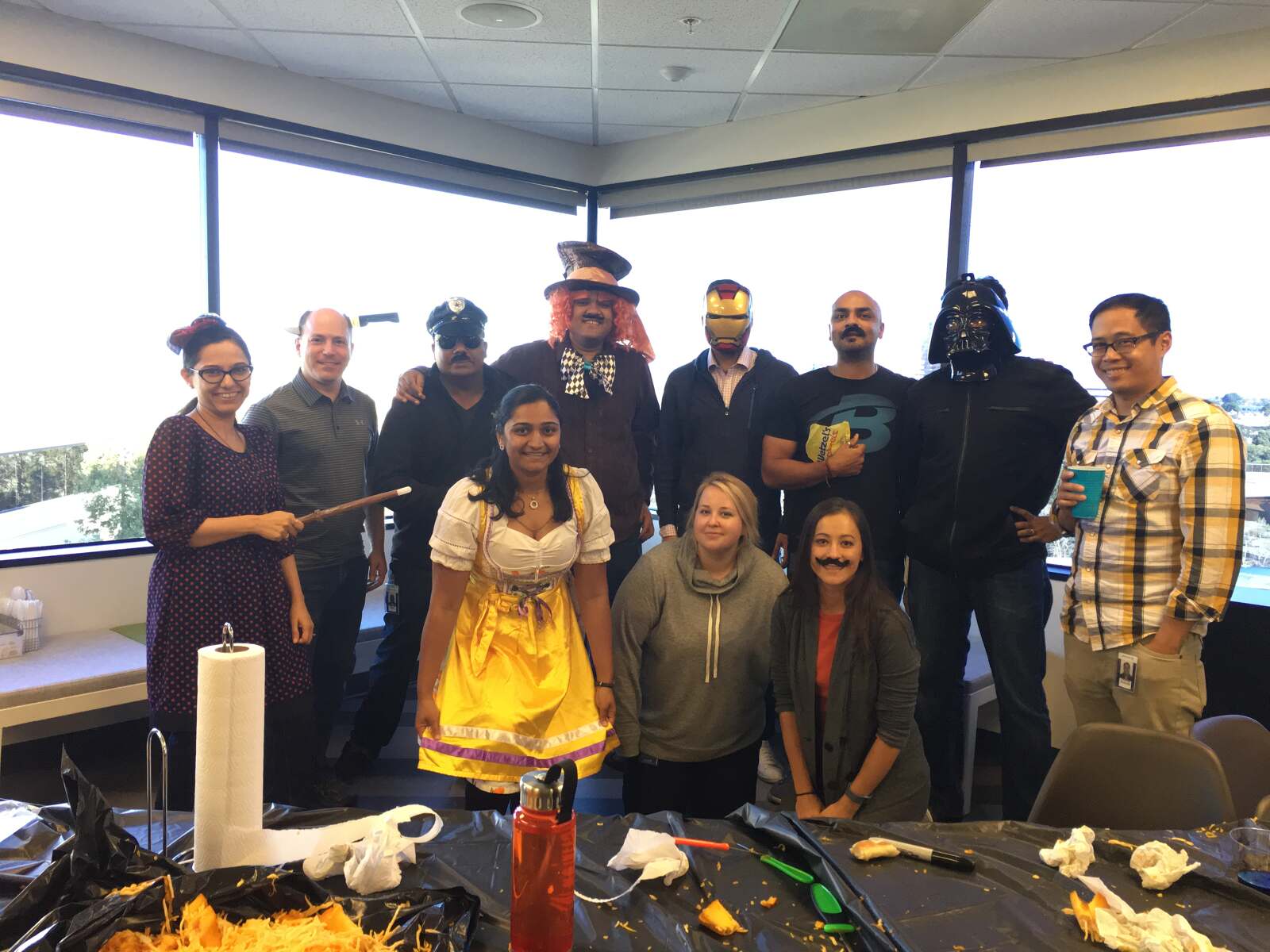
Eleven team members posed together in Halloween costumes, including Darth Vader, Iron Man, a mad hatter and a police officer, in front of a table covered in carved pumpkin and newspaper
Halloween, 2016. Pumpkins carved on the table in front. Under a problem list that includes loss of trust and burnout, this is not a perk. It is maintenance.↗ open full size

09 · What I would defend

I do not have adoption or delivery figures from this period, so none are claimed here. What I would put in front of a hiring manager is the method.

A team told me what was wrong, in their own words, on a wall. I turned it into one sentence, a definition, eight owned initiatives, and a line item in the system that decides people's raises. That sequence is the transferable part, and it is close to the sequence I used at BlackBerry the following year on a much larger function.

Captions on this page are read from the artifacts themselves. Where a phrase appears in bold it is transcribed from the whiteboard or slide beside it.

10 · Takeaways

01 Name the problem in one line and the argument becomes portable. A design team versus teams of designers traveled further than any slide I could have written.
02 Diagnose with the team, not for them. Every problem on that wall came from a designer, which is why nobody had to be persuaded the diagnosis was fair.
03 A strategy that lives in a deck is a wish. Putting design goals into Workday and performance reviews is what made them the work rather than extra work.
04 Embedding designers in delivery teams solves proximity and creates isolation. Both are true, and the second is the part nobody plans for.
05 Ask for thirty minutes, not an hour. A tight case with a stated objective gets heard. A broad one gets deferred.
06 The most useful thing on that whiteboard was not a solution. It was the sentence design is our house, we need to fix it.

Embedding designers solves proximity and creates isolation. Both are true.
Next case studyEarning a teamRead the case study