A generative AI control layer for enterprise security
Enterprise IT blocked Siri and Google Assistant from BlackBerry Work because both leaked sensitive suggestions from the secure container. In my first week at BlackBerry, I designed and prototyped Berry: an AI assistant that lives natively inside Work's secure workspace, so employees get a conversational executive assistant without the data ever leaving the container it was never allowed to leave.

With Siri and Google Assistant blocked, enterprise users had no assistant at all on the phones they worked from.
60-second read
Siri and Google Assistant could surface sensitive Work data in OS-level suggestions, so IT blocked both from devices running BlackBerry Work entirely.
Build the assistant natively inside the secure container itself, so it never has to ask the OS for anything the container was built to keep in.
Designed every screen and micro-interaction, mapped the conversation logic, and built a fully workable prototype deployable to any iPhone in one week.
This was a one-week concept prototype, not a shipped feature. It is here for the product thinking, not adoption numbers.
01 · Why now
Business data was piling up faster than anyone could recall it, spread across a growing pile of apps, while conversational AI was finally cheap enough to build with.
Four things lined up at once: data overload made information hard to recall in the moment, app fatigue meant people were bouncing between tools just to get one thing done, messaging was already the interface people preferred, and NLU had gotten good and cheap enough to build an assistant with. BlackBerry had one thing none of the OS-level assistants had: standing access to business data inside a secure container, on a major mobile platform.
02 · The opportunity
A door no one else had
Siri, Google Now, and Bixby had no access to the secure container on a major mobile platform. We did.
First mover
A chance to be first to a mobile enterprise AI platform across iOS, Android, and desktop.
A natural extension
It sat on top of the BlackBerry Dynamics platform rather than beside it, so it strengthened what already shipped.
A unifying layer
One conversational surface across the software portfolio, instead of one more standalone app.
03 · What Berry does
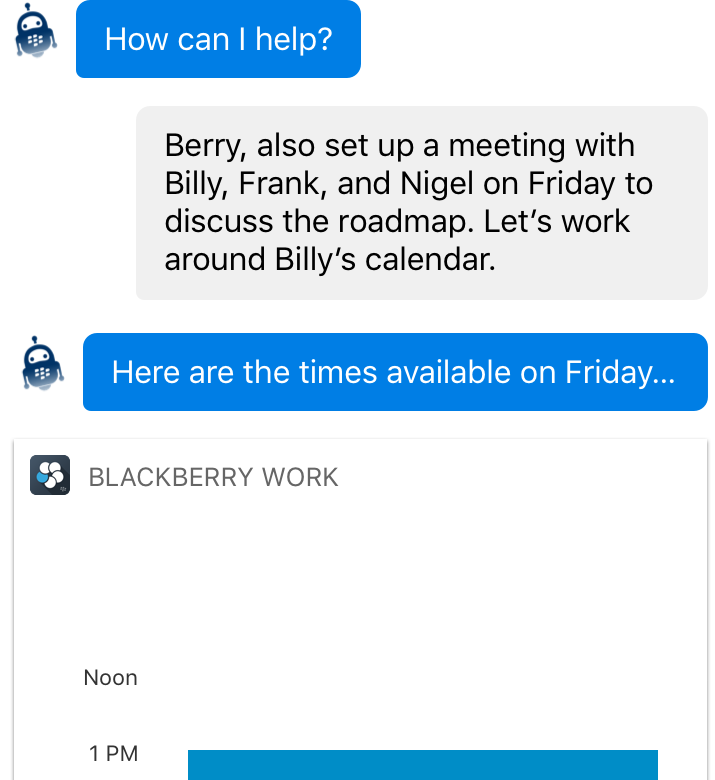
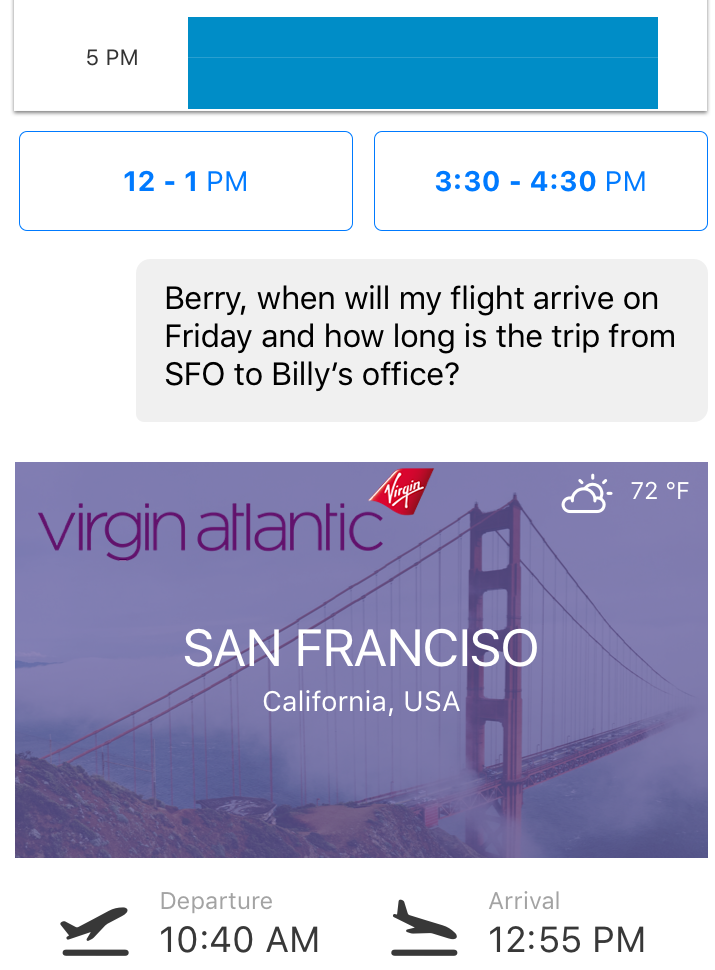
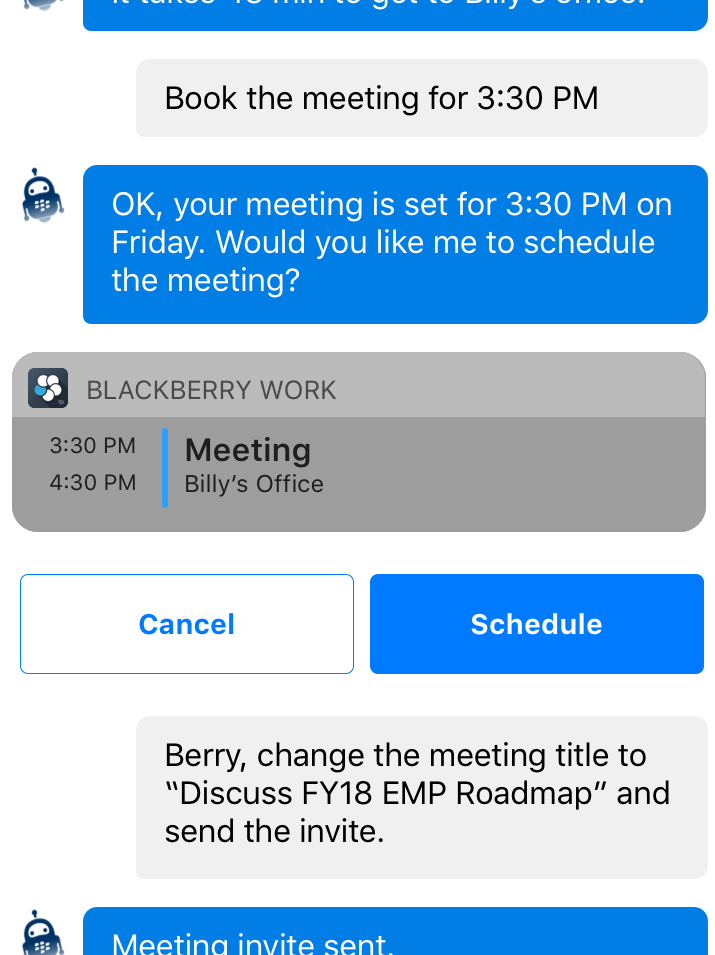
Berry acts as an executive assistant with standing access to a user's corporate data: calendars, travel, and messaging, resolved through natural language instead of five separate apps. A single request, schedule a meeting around a colleague's availability, chains into checking a flight, calculating drive time, and sending the invite, without the user ever leaving the thread.
04 · Staying inside the container
Enterprise IT had blocked Siri and Google Assistant for a real reason: both surfaced Work data in OS-level suggestions that lived outside anyone's control. The fix wasn't to ask IT for an exception. It was to design Berry so it never needed one, native to the app, living inside the NOC, cleanly separated from the personal side of the device by construction rather than by policy.
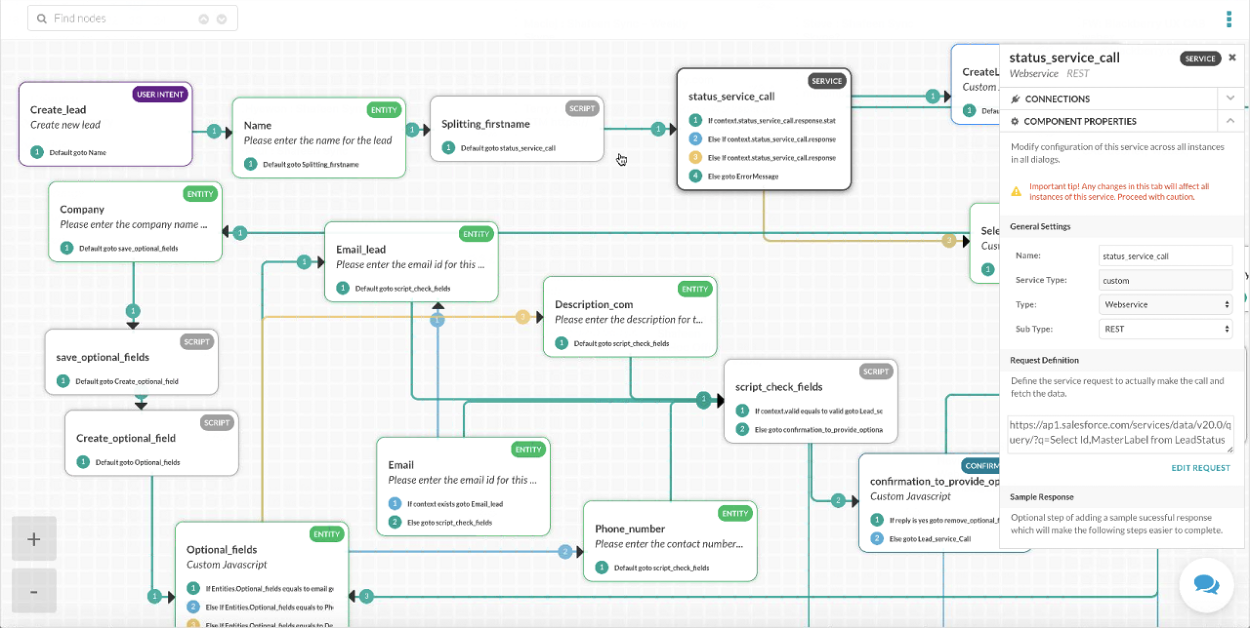
I explored several implementation paths for where the conversation logic and service calls should live, weighing how each one held up against that same constraint: nothing crosses the container boundary that isn't supposed to.
Trade-offs
Solve the trust problem first. The AI comes after.